


近日,音乐与舞蹈学院孙健副教授课题组联合澳大利亚斯威本科技大学、悉尼大学、荷兰布雷达应用科技大学的学者共同在教育学权威期刊《Education and Information Technologies》(SSCI一区,IF:5.4,IF排名:22/756)发表题为“Human-AI co-creation or conflict? Mapping art students' diverse perspectives on creative identity with genAI: A Q methodology study”的研究论文。该论文以西华大学为第一署名单位,孙健副教授为第一通讯作者,美术与设计学院吴昊副教授、王筱阳老师为共同研究人员。
论文截图
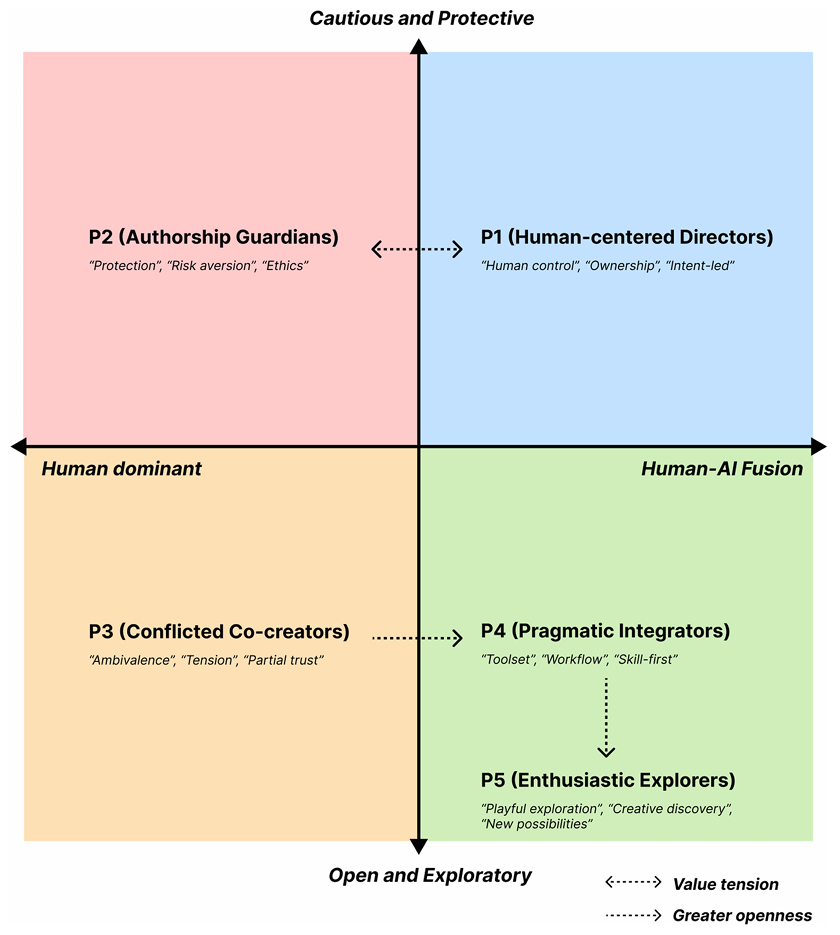
随着生成式AI在艺术创作领域的广泛应用,其对艺术生创作身份认知、传统艺术教育模式带来新挑战,而现有研究多忽视了学生对GenAI认知的多元性。课题组创新采用Q方法论,选取多所高校40名有GenAI创作实践的艺术专业本、硕、博学生为研究对象,覆盖音乐、舞蹈、设计、动画、美术等多个学科,经系统分析首次识别出艺术生面对GenAI的五种典型认知视角:人本导向的主导者、作者权的捍卫者、内心矛盾的协作者、实用主义的整合者、热情探索的创新者。
基于这一核心发现,团队构建了“创作作者权控制—AI 协同开放度”二维分析框架,结合中国文化与教育语境剖析了影响学生认知的关键因素,并针对五类学生提出了强化核心技艺培养、融入AI伦理教育、构建创作心理安全感等定制化教学策略,同时为设计人本导向的创作型 GenAI 工具提供了思路。
该研究成果的发表,是学校在艺术教育与人工智能交叉领域的重要学术突破,彰显了学校跨学科、国际化的研究能力。未来,研究团队将持续聚焦生成式 AI 与音乐、舞蹈等表演艺术的融合研究,探索适配的人机协同创作与教学模式,助力培养兼具传统艺术素养与数字创新能力的高素质艺术人才。
研究图文
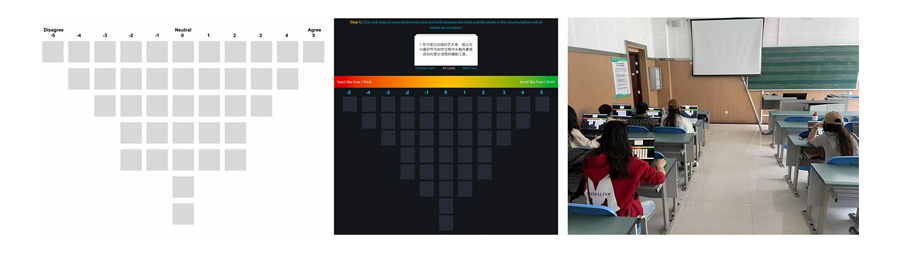
Fig. 1 Q-sort procedure and setting. Left: blank Q-sort grid structured as a forced quasi-normal distri bution (−5 to +5). Middle: screenshot of the online drag-and-drop interface. The top panel presents the remaining statements from the Q sample as cards (one card shown at a time), with controls to browse the full set (e.g., previous/next). The lower panel shows the target sorting grid with labeled anchors (“least like how I think” to “most like how I think”) and a color-coded −5 to +5 scale; participants repeatedly drag cards from the statement pool into the grid until all slots are populated. Right: Q-sort session in the classroom setting.
研究图文
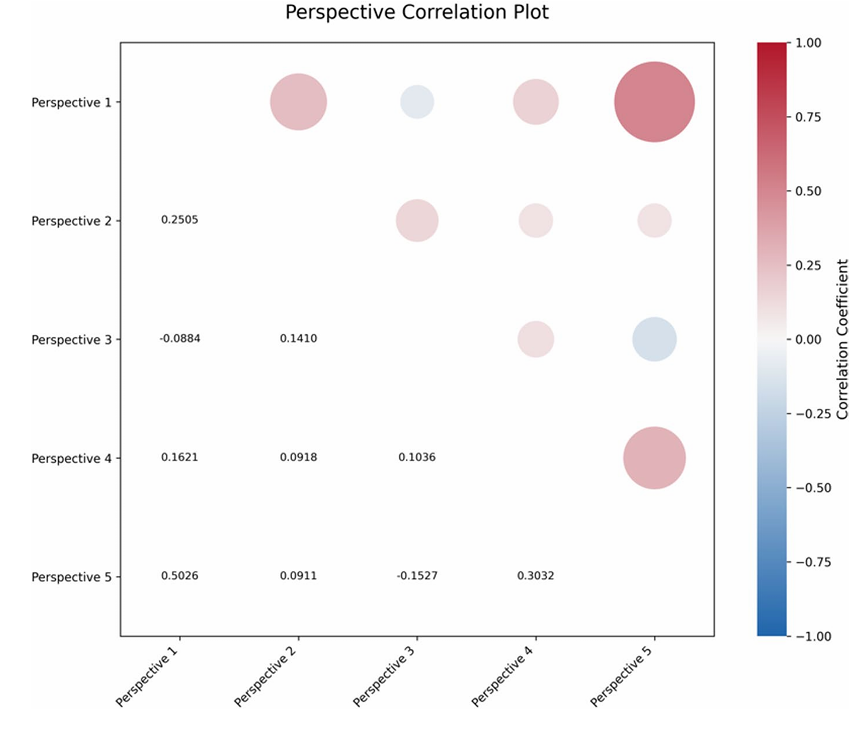
Fig. 2 Factor Score Correlations. Note. Numerical values represent the correlation coefficients between factors (perspectives). The color indicates the direction of the correlation (red = positive; blue = nega tive), and the dot size is proportional to the magnitude of the correlation coefficient. How to interpret this chart: For example, strong alignment (large red dots): A high positive value and a large red dot, such as the intersection of Perspective 1 (Directors) and Perspective 5 (Explorers) (r = 0.5026), indi cates these groups share significant common ground. Divergent views (blue dots): a negative value and blue dot, for instance, between Perspective 3 (Conflicted) and Perspective 5 (Explorers) (r = −0.1527), highlights a clash in perspectives.
研究图文
Fig. 3 A two-dimensional matrix showing student perspectives on GenAI. Bidirectional arrows denote conceptual tensions between neighboring perspectives, and dashed arrows indicate relative differences in openness across perspectives.


 川公网安备 51010602000503号